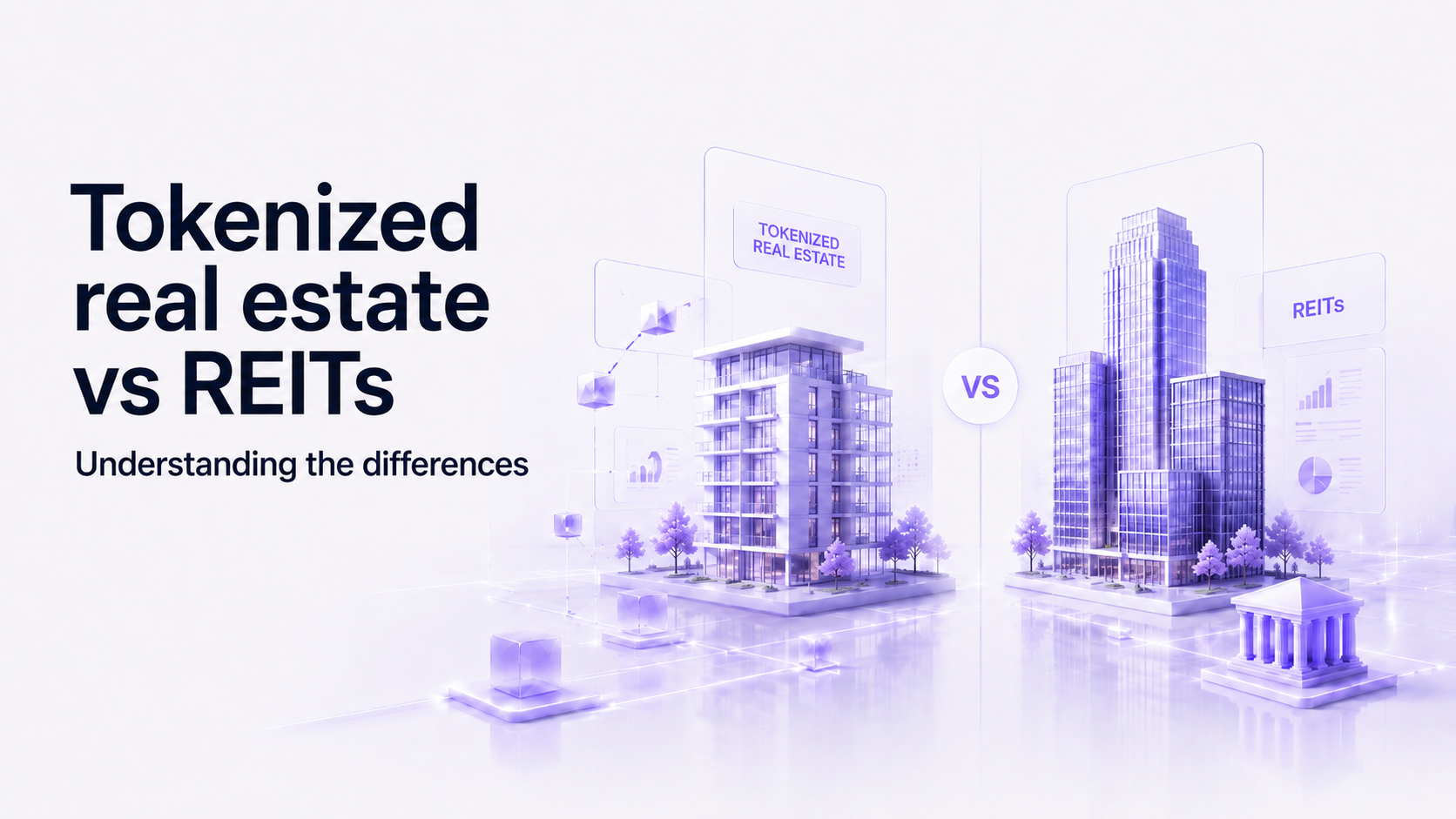
Tokenized real estate and REITs (real estate investment trusts) provide investors with exposure to property markets without requiring them to purchase an entire property. This article explains the key differences between the two.
- What are REITs and Tokenized Real Estate?
Ownership Structure and Investor Rights
Liquidity Expectations and Secondary Markets
Fees, Transparency and Reporting
- Which Model Suits Different Investor Profiles?
Conclusion
- What are REITs and Tokenized Real Estate?
Before we start a nuanced analysis, let’s take a look at the most standout differences between REITs and tokenized real estate.
REITs emerged more than 50 years before tokenized real estate. The two models differ in how investor rights are structured and managed, as well as in their ownership structures, liquidity mechanisms, and reporting standards.
REITs allow investors to gain exposure to real estate in much the same way that stocks and bonds provide exposure to other asset classes. Most REITs are publicly traded. Shares in publicly traded REITs can typically be purchased through brokerage accounts and stock exchanges.
Tokenized real estate is built on blockchain infrastructure where all the data is recorded and managed. The digital nature of property tokens may provide broader market access and simplify certain administrative processes. In some cases, it may also reduce reliance on certain intermediaries.
Ownership Structure and Investor Rights
Since neither REITs nor tokenized real estate typically provide investors with direct ownership of real estate, it’s important to realize what exactly do investors get when they buy property tokens or shares in REITs.
REIT investors get shares in a company or trust, standard shareholder rights, and indirect exposure to a real estate portfolio.
Tokenized real estate typically gives investors an interest in a legal structure associated with the property. It may be an SPV or another structure. Real estate tokens are often linked to a specific property. Rights granted to investors may vary depending on issuer and jurisdiction.
Liquidity Expectations and Secondary Markets
Once you hold an asset, eventually you may want to sell it. So which one is easier to sell, REITs or tokenized real estate? The answer is pretty straightforward. Since REITs are a mature asset class with decades of market history, they generally benefit from deeper liquidity and more developed market infrastructure than tokenized real estate. Publicly traded REIT shares are normally traded during market hours via brokerage accounts.
In this regard, tokenized real estate is a different thing. The tokens are dependent on the secondary markets availability, trading activity, and platform-specific restrictions. Thus, some of the tokenized property projects are easy to trade while others only provide a limited set of opportunities. All these things are needed to be factored in while choosing a tokenized real estate to invest in.
Where tokenized real estate shows more flexibility is the entrance threshold. Whereas REITs investment minimum usually starts with a single share which may cost ten to hundreds of dollars, tokenized real estate allows investors to benefit from lower and more flexible investment minimums ranging from as little as $50–$100 to a few thousands dollars. For instance, the fractional real estate investing platform Lofty accepts investments starting at $50. Similar minimum investment amounts can be found on the RealT marketplace. Other companies may have a higher minimum investment requirements, starting at $1,000 or more.
Tokenized real estate usually can be traded around the clock. However, the practical value of this feature heavily depends on trading activity and liquidity. The lack of liquidity in the tokenized real estate market is rather a misconception. This market is nascent and keeps on growing rapidly. Some market forecasts project significant (over 300%) growth for the sector over the coming decade.
What makes this asset type attractive is that investors may benefit from the underlying property while buying or selling it doesn’t take as long as in the case with conventional real estate. Instead of waiting for weeks or even months, token transfers can often be completed within seconds.
Generally, it’s safe to say that currently REITs keep on being an easier to sell asset than a tokenized real estate, however, its dominance is not absolute and may shrink in the years to come.
Fees, Transparency and Reporting
How much information can investors expect to receive? Transparency is important for investors, so let’s see how transparent are REITs and property tokens and how fair are reporting and fees.
REIT disclosures
Listed REITs provide investors with much transparency as any other publicly traded entity as it’s required by the law. REITs regularly report on potential risks and gains and disclose important financial information.
The list of disclosed information normally includes the following:
Funds From Operations (FFO), a commonly used REIT performance metric that adjusts net income by adding back depreciation and amortization and excluding gains or losses from property sales. For instance, a company may disclose payout ratio per unit as a % of FFO.
Adjusted Funds From Operations (AFFO), which further adjusts FFO to account for recurring capital expenditures and certain other non-cash items.
Net Operating Income (NOI), which measures property revenue minus operating expenses, excluding financing costs and taxes.
Dividend information, information about payouts, yield, etc.
Tokenized real estate disclosures
Tokenized real estate disclosures may include the following:
Legal structure. It includes the entity type (SPV or LLC), token nature (whether it is a share in SPV, property secured debt, or a revenue-sharing agreement), jurisdiction, and voting rights.
Financial data and property information. This may include appraisals, rent rolls, occupancy data, and operating performance metrics.
Proof of compliance with the local financial regulators.
Lock-up periods.
Blockchain functioning. Investors get info about token protocols, available secondary markets, and smart contract audits.
You can find an example of an investment memorandum used in a tokenized real-world asset offering here.
The difference between the info disclosed by tokenized real estate and REITs underlines their different status in the financial world with the latter being a long-time adopted and regulated asset while the former is going through a formative period.
- Which Model Suits Different Investor Profiles?
Competitive dividend yields, investor protections stemming from regulators, and good liquidity make REITs a better fit for investors looking for diversification and passive income. As of 2026, the average dividend yield of U.S. equity REITs was approximately 3.7–4.0%. For comparison, the dividend yield of the S&P 500 was around 1%. Listed U.S. REITs also benefit from deep secondary markets, with average daily trading volumes exceeding $11 billion.
Tokenized real estate may be a better fit for investors looking to try out new zones, explore newer investment models that may offer different risk-return characteristics. On top of that, tokenized real estate may be a good fit for retail investors who may quickly invest a few hundreds dollars into some property and enjoy the respective benefits without much hassle.
Both models suit investors that prefer to stay away from complexities of purchasing and owning real estate directly.
Conclusion
Tokenized real estate may offer access to a broader range of individual properties and lower investment minimums. Fractional ownership opens an opportunity even for investors with small resources. REITs provide a higher liquidity and have stronger regulatory protections and better established secondary markets. Both models can serve different investor needs and portfolio objectives.